

Writer: Patrick Melville
In 2013, the World Health Organisation launched an annual campaign called World Mental Health Day. They recognised that mental health was a common challenge for every culture, race, age, and more groups. Their goal was to use their global reach to drive a simple message: “to raise awareness, mobilise support, and set political priorities for mental health worldwide.”
Whilst knowledge is good, there are barriers that stop people from finding help, otherwise known as ‘stigmas’. The national organisation, MHFA England, gives a suitable visual to understand where mental health can go if these are not addressed. It is called the Mental Health Continuum and shows how everyone’s mental health is fluid and changes over time.
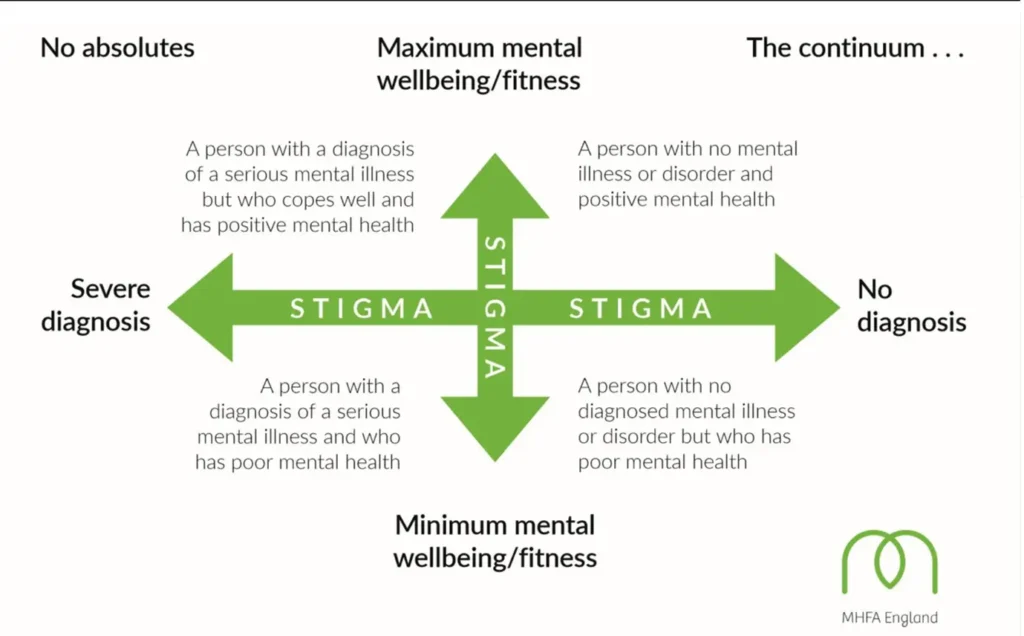
You will see that there are four quadrants (top right Q1, bottom right Q2, bottom left Q3 & top left Q4) and two axes: The main learning from this diagram is to see how the mental health lowers without help: from Q1 downwards and into Q2 and Q3. It is possible to have a mental condition, but with suitable care, you can still have positive mental health, shown in Q4.
Tip: Notice how your mental health, and those around you, are continuously moving due to daily pressures.
So, if we understand that we need to invest our time to stay in Q1, or Q4, how can we do this?
William Sturges and the law industry have used this knowledge to de-stigmatise the need to keep in Q1; like issuing this article.
The next step is to build techniques using this knowledge. A good example is managing stress. It is well known that stress has a high impact in the legal sector. “Mental health challenges reduce productivity by 19%, with much of the impact driven by stress and presenteeism” (Legal Futures)
It is important to understand that it is OK to experience stress – it is unavoidable.
According to WHO “the way we respond to stress, however, makes a big difference to our overall well-being.”
Stress can be beneficial, also called “healthy stress.” A good example is before a big client meeting or an in-house presentation. You can feel stressed, but it can be channelled as a useful motivator and to help focus.
Tip: In a short period of time, acknowledge that it is ok to be stressed. This can be planning and actioning for a big meeting or project. Channel your thoughts by reminding yourself that it will help you deliver your work and personal goal.
In the short term, that is a positive form of mental health. However, if the stress carries on longer and has a bigger life impact, then that is when one needs to take action. This can lead to a common mental health condition linked to work in law, including depression, anxiety disorders, and stress-related conditions (often triggered by major work or life changes).
Tip: Notice a specific negative thought or feeling in a moment when you are stressed. Ask yourself, is it specifically linked to that moment? How long have you felt this? Has it interrupted non-related parts of your day?
When we notice how unmanaged stress can become a risk factor for developing mental health conditions, aka going into Q2 in the Mental Health Continuum, it is important to notice how to manage it.
A good visual is the MHFA England Stress Container:

- The size of the container represents the vulnerability of everyone’s mental health.
- The stressors (longer hours for clients, more last-minute changes, higher billable targets) will naturally fill the container quicker.
There are two ways to de-stress:
- No action filter – this can lead to the stress container overflowing and cause “no control” feelings and thoughts, and ‘burn-out’.
- Action filter – actively opening the “tap” to actively let the stress out.
The goal isn’t to remove stress – it’s to help the mind, whatever is happening around you.
Some key tips are to note:
Tip: Recognise any early warning signs. Your higher stress container will drive this. The aim is to notice what has changed and how long it has been. The changes can be habits (sleep changes) or reactions to moments that would normally be “OK” but instead cause irritability or withdrawal.
Tip: Go to your own Stress Container tap. Ask yourself what helps you. These can be self-care techniques, peer support (including your MHFAiders®), access to EAP services, support outside the company and, just talking to a trusted source.
Tip: Regular reviews of your tap. Your reviews are essential to ensure that your tap does not get clogged up. A good example is drinking coffee or tea – one cup might be OK, but not 25!
Tip: Ask a trusted colleague or family member what they do to open their tap? By asking them, you might get ideas for yourself, reduce your stress, or you might encourage them to find their own way.
Tip: Use physical moments to self-care. Go for a walk, listen to a song – what can you ‘enjoy’ for 10 minutes?
Tip: When in the office, get off your desk and talk to a colleague. Choose 3 people per week to approach and just say, ‘hi, how are you’? You can mention this article to them….
Tip: Contact MHFAider® in your business. Feel free to get in touch and ask them to show you the MHFAider® app.
These are some ways to self-care and understand how you can support your colleagues. Just reading this and actioning parts will bring you into the global push with World Mental Health Day and further. You are joining their goal to normalise the idea that anyone, including yourself, can access help quicker and recover quicker to hit your goals. Feel free to get in touch with Patrick Melville, patrick@melville-solutions.com